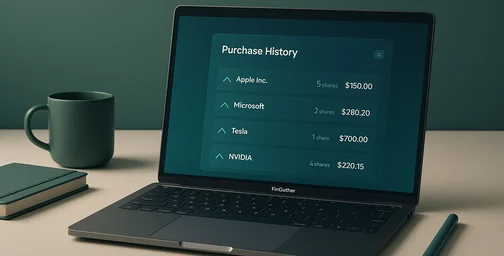
Keeping track of your investment portfolio sounds manageable when you only make a few trades.
You buy a stock, maybe add an ETF, and assume your broker history will be enough. For a while, that often works. But as your portfolio grows, your transaction history becomes more important — and also much easier to lose control of.
You buy the same asset multiple times. You invest across different dates and prices. You may use more than one broker. Some transactions are long-term investments, others are smaller additions, and after a while, the whole picture starts getting harder to follow.
That is usually the moment when investors realize they do not just need to track what they own. They also need a clean way to track how they got there.
In this article, we will look at why transaction tracking becomes messy, what information actually matters, which mistakes investors make most often, and how to build a cleaner workflow for stock purchases and investment transactions.
Why transaction tracking gets messy so quickly
The first problem is simple: transactions pile up faster than most investors expect.
At the beginning, your portfolio history is easy to remember. You know when you bought something and roughly why. But once you keep investing regularly, averaging into positions, adding ETFs, or buying across multiple market dips, that memory becomes unreliable.
Broker platforms do store trade history, of course. But broker history is not always the same as usable portfolio clarity.
A broker may show a list of executed trades, but that does not automatically give you:
- a clean overview of your cost basis
- an easy way to understand position building over time
- a portfolio-wide view across multiple holdings
- or a practical system you actually want to review regularly
Another common issue is fragmentation. Part of your history sits with one broker, part with another, part in spreadsheets, and part in your head. Once your transaction history is scattered across too many places, it becomes harder to trust your own overview.
That is where mess starts. And once the tracking system becomes messy, decision-making usually gets worse too.
Why transaction history matters more than many investors think
Many investors focus mostly on current portfolio value. That number matters, of course, but it tells only part of the story.
Without transaction history, you lose the path that created the portfolio.
That path matters because it helps you understand:
- when you entered a position
- how you built it over time
- what your average cost may look like
- how active or passive your investing behavior really is
- and whether your portfolio decisions are consistent with your strategy
If you only look at the current state of your holdings, you miss a lot of context.
A clean transaction history turns your portfolio from a static snapshot into something you can actually understand. If you want the broader framework for that, start with How to Track Your Investment Portfolio Without Chaos.
What information you should track for each investment transaction
You do not need an overcomplicated system. But you do need a reliable one.
For each investment transaction, it usually makes sense to track:
- the asset
- the date
- the transaction type
- the quantity
- the price per share or unit
- the total value
- and any fees or related costs
That is the practical core.
Depending on your workflow, it can also be useful to keep simple notes around:
- why you opened or added to the position
- whether the trade was part of a planned allocation decision
- or whether it was tied to a specific investing idea
The goal is not to turn every transaction into a journal entry. The goal is to preserve enough context that the portfolio still makes sense later.
Because if you do not record transactions properly when they happen, reconstructing them later becomes frustrating very quickly.
The problem with relying only on broker history
Broker history is useful, but it has limits.
The main problem is that broker records are often designed for execution, not for broader portfolio clarity.
They help you see that a trade happened. They do not always help you understand:
- how that trade fits into the portfolio
- how multiple transactions built one position
- how your investing behavior evolves over time
- or how everything connects across holdings, watchlist, and portfolio structure
If you use multiple brokers, the problem gets even worse. Then your investment history is split across separate systems that were never designed to work together.
This is one of the reasons many investors eventually outgrow just checking the broker app. Not because broker data is useless, but because it stops being enough.
The most common mistakes investors make when tracking transactions
There are a few mistakes that show up again and again.
1. Recording transactions too late
This is probably the most common problem.
You make a purchase, assume you will record it later, and then a few days or weeks pass. Suddenly you are no longer fully sure about:
- the exact price
- the fee
- the date
- or the context of the trade
Small delays create large mess over time.
2. Keeping only partial records
Some investors track the asset and quantity, but ignore fees. Others record purchases but not sales. Some track transactions for one broker but not another.
Partial tracking creates false clarity. It looks organized on the surface, but the picture is incomplete.
3. Mixing portfolio tracking with random notes
Spreadsheets, screenshots, note apps, email confirmations, and broker exports can all become part of the same improvised system.
That may feel manageable in the short term, but it creates too much friction in the long term.
4. Tracking holdings but not the process behind them
A lot of investors know what they currently own, but cannot easily explain how they built the position. That missing history makes the portfolio harder to evaluate.
5. Making the system too complicated
There is an opposite mistake too: building a transaction tracking process so detailed that it becomes annoying to maintain.
A system that is too heavy will eventually be ignored. Simplicity matters.
A cleaner workflow for tracking stock purchases and investment transactions
The best transaction tracking workflow is usually the one that feels sustainable.
That means:
- easy enough to maintain consistently
- detailed enough to stay useful
- and connected enough to your broader portfolio workflow
A practical system usually works like this:
Keep transactions in one central place
Even if you invest through multiple accounts or brokers, your transaction history should be visible in one consistent system.
That reduces fragmentation and gives you a clearer portfolio picture.
Record trades as they happen
The closer you record the transaction to the actual trade, the less friction you create later.
This one habit prevents a surprising amount of chaos.
Make transaction history part of portfolio understanding
Transactions should not just sit in a hidden list somewhere. They should support your understanding of:
- position size
- portfolio structure
- portfolio development
- and overall investing behavior
Keep the system simple enough to use long term
You do not need twenty custom fields and color-coded formulas unless you genuinely enjoy that kind of maintenance.
For most investors, the better solution is a clean, reliable workflow that removes friction instead of adding more of it.
Why spreadsheets become harder to maintain over time
Many investors start by tracking stock purchases in spreadsheets.
That is understandable. Spreadsheets are flexible, familiar, and easy to customize. But they also make you responsible for everything:
- data entry
- formulas
- updates
- consistency
- and ongoing maintenance
That works at first. Over time, it creates drag.
The issue is not that spreadsheets are bad. The issue is that they turn transaction tracking into a manual system that depends entirely on your own discipline.
Once you have a growing portfolio, repeated purchases, multiple holdings, and maybe multiple brokers, the spreadsheet often stops feeling like clarity and starts feeling like admin work.
At that point, many investors do not need a better spreadsheet. They need a better workflow. If you are still deciding between those two paths, compare them in Excel vs Portfolio Tracker: What Makes More Sense for Investors?.
What to look for in a transaction tracking setup
If you want to track investment transactions without mess, the right system should help you do a few things well.
It should make it easy to:
- log purchases and sales clearly
- understand how positions were built
- connect transactions to the overall portfolio
- avoid scattered records across multiple tools
- and review your investing activity without unnecessary effort
That is the real standard.
Not maximum features. Not institutional-grade complexity. Just practical clarity.
For most stock and ETF investors, that matters much more.
Why transaction tracking works better inside a full portfolio workflow
Investment transactions make the most sense when they are not isolated from everything else.
They work better when they are part of the same system as:
- your holdings
- your portfolio overview
- your watchlist
- and your dividend visibility
If you want to tighten those surrounding layers too, see How to Build a Stock Watchlist Without Losing Good Investment Ideas and Dividend Tracker: How to Track Dividends and Yield Without Spreadsheets.
That is because investing is not a set of disconnected tasks.
Buying, tracking, reviewing, and managing ideas all belong to one broader workflow. If transactions live separately from the rest of that workflow, clarity suffers.
A better setup keeps those pieces connected.
That is also where product positioning becomes relevant. Many investors do not need the broadest wealth platform or the most advanced analytics engine. They need a clean and practical system that helps them stay organized.
That promise is more useful than hype.
Final thoughts
Tracking stock purchases and investment transactions should not feel like bookkeeping punishment.
If your portfolio is growing, transaction history becomes part of staying organized, understanding your decisions, and keeping the whole system manageable. The goal is not to track every possible detail. The goal is to preserve enough clarity that your portfolio still makes sense over time.
That means:
- recording transactions consistently
- keeping them in one usable system
- and connecting them to the broader portfolio view
If your current setup feels messy, scattered, or too manual, that is usually a sign that the workflow needs to improve.
If you want to track your portfolio, transactions, watchlist, and dividends in one clearer workflow, FinGather is built to help investors stay organized with more clarity and less chaos.