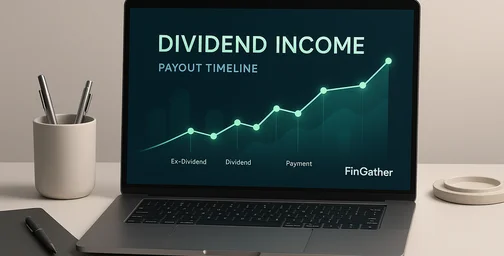
If you invest in dividend-paying stocks or ETFs, tracking your income should feel straightforward. In reality, it often turns into a messy mix of spreadsheets, broker screens, notes, and half-updated calculations.
At first, it seems manageable. You have a few positions, a few payouts, and maybe one simple sheet to keep everything in order. But as your portfolio grows, dividend tracking gets more complicated. Different holdings pay at different times. Some payouts arrive monthly, others quarterly. You may hold assets in multiple currencies. And if you want a clear overview of dividend income, yield, and payout history, the whole system can start feeling much heavier than it should.
That is why many investors start looking for a better dividend tracker.
The goal is not to build a perfect data machine. The goal is to make your portfolio easier to understand. A good dividend tracking workflow should help you see what you own, what it pays, and how it fits into the bigger picture of your investing. It should give you more clarity and less chaos.
Why dividend tracking gets messy so quickly
Dividend investing sounds simple on paper. You buy income-producing assets and track what they pay. But once you move beyond a very small portfolio, the friction starts to show.
One problem is fragmentation. Your broker may show recent payouts, but not always in the format you want. Another platform may help with analysis, but not with the full portfolio picture. Your spreadsheet may contain custom calculations, but only if you keep updating it manually.
Another issue is that dividends do not exist in isolation. They are tied to positions, transactions, portfolio allocation, performance, and sometimes your own long-term investing goals. If you track dividends separately from the rest of your portfolio, you often lose context. That broader context is easier to see once you have a cleaner core system, which is why it helps to start with How to Track Your Investment Portfolio Without Chaos.
This is where the process starts breaking down. Instead of having one clean workflow, you end up with multiple partial systems:
- a broker app for holdings
- a spreadsheet for dividend income
- notes for payout expectations
- another tool for portfolio performance
It works for a while, but it creates unnecessary mental overhead. The more tools you need to maintain, the more likely it is that something becomes outdated, inconsistent, or simply annoying to use.
What a good dividend tracker should help you see
A dividend tracker should do more than list past payments. It should help you understand your portfolio in a practical way.
At a minimum, it should make it easy to see:
- your dividend-paying holdings
- past payouts
- expected dividend income
- yield in a useful context
- how dividends relate to the rest of your portfolio
That last point matters more than many investors realize. Dividend data is useful, but only when it supports better visibility into your overall investing workflow. You do not just want to know that a payment arrived. You want to understand what role that holding plays in your portfolio, how it contributes to your income, and whether your system still feels manageable as the portfolio grows.
A good dividend tracker should reduce friction. It should help you answer simple questions quickly:
- Which holdings generate income?
- What has been paid already?
- What does my dividend picture look like across the portfolio?
- Am I looking at a clean system or just a pile of manual workarounds?
If your current setup makes these answers harder instead of easier, the setup is the problem.
The problem with tracking dividends in spreadsheets
Spreadsheets are useful. They are flexible, familiar, and easy to start with. For many investors, they are the default first step.
But spreadsheets also create a specific kind of hidden cost: maintenance.
Every spreadsheet-based dividend tracker depends on your own discipline. You have to update positions, add transactions, adjust formulas, check payout data, and keep the whole thing consistent over time. That may be fine with five holdings. It becomes much less fine when you have a growing portfolio and less patience for administrative work.
The biggest weakness of spreadsheets is not that they are bad. It is that they push too much of the system onto you.
You become responsible for:
- keeping the data current
- preventing formula mistakes
- updating structure as the portfolio changes
- maintaining clarity across different holdings and payouts
And once the sheet becomes complicated, it stops feeling like a helpful overview and starts feeling like a fragile tool you are slightly afraid to touch.
That is usually the point when investors realize they do not actually want a better spreadsheet. They want a better workflow.
A simpler way to track dividends
The simplest approach is to stop treating dividends as a separate universe.
Instead of building one workflow for your holdings, another for transactions, and another for dividend income, it makes more sense to keep them connected. Dividends are part of your portfolio. They should be visible inside the same system that helps you understand the rest of your investing activity.
A cleaner dividend tracking workflow looks something like this:
- your holdings are organized in one place
- your transactions support the portfolio history
- dividend-related visibility is part of the same overview
- you do not need to jump between multiple disconnected tools just to understand what is happening
This matters because the real benefit is not just data collection. It is decision clarity.
If your dividend tracking setup feels simple, you are more likely to keep using it. If it gives you useful context without extra maintenance, it becomes part of a healthy long-term investing workflow rather than a side project.
For stock and ETF investors especially, that simplicity is valuable. You do not need an overengineered system. You need a practical one. And if your transaction records are already messy, it also helps to fix that layer directly in How to Track Stock Purchases and Investment Transactions Without Mess.
What to look for in a dividend tracker
If you are choosing a dividend tracker or rethinking your current setup, focus on practical usefulness rather than feature overload.
A good dividend tracker should offer:
1. A clear dividend overview
You should be able to understand your income picture quickly, without digging through tabs or exporting data into another sheet.
2. Connection to your actual portfolio
Dividend data should not live in a vacuum. It should make sense within the context of your holdings and broader portfolio structure.
3. Easy navigation and low friction
If the tool feels heavy, cluttered, or overly analytical for your needs, it will create the same problem you were trying to solve.
4. Useful history and context
Past payouts matter, but so does understanding how those payouts relate to portfolio decisions and long-term tracking.
5. Support for stock and ETF investors
The workflow should fit the needs of investors who want practical portfolio clarity, not a giant institutional-style analytics terminal.
This is why many investors eventually move away from patchwork tracking systems. Not because they suddenly need more complexity, but because they want less of the wrong kind.
Why dividend tracking works better as part of a full portfolio workflow
The strongest setup is usually not the one with the most dividend-specific features. It is the one that makes your overall investing system easier to manage.
Dividend tracking becomes more useful when it sits inside a broader workflow that includes:
- portfolio tracking
- transaction history
- watchlist management
- performance visibility
- clear organization across holdings
If you want to tighten up the watchlist side of that workflow too, see How to Build a Stock Watchlist Without Losing Good Investment Ideas.
That kind of setup reduces tool-switching and keeps your investing process more coherent.
For example, if you are reviewing your portfolio, you may want to understand not only what you own, but also how income-producing positions fit into the bigger picture. Are you building for growth, income, or a mix of both? Which holdings are central? Which ones are just noise? Those questions are much easier to answer when dividends are visible inside the same clean system.
This is also where product positioning matters. Many investors do not need the broadest platform or the most advanced analytics engine. They need a modern, trustworthy, practical tool that helps them stay organized.
That is a different promise. And for many people, it is the better one.
Spreadsheets are not the enemy — chaos is
It is easy to frame this as a battle between spreadsheets and apps, but that is not really the point.
Spreadsheets can be perfectly fine for some investors. If your portfolio is small and your process is stable, a simple sheet may be enough. The problem starts when the system no longer matches the complexity of your workflow.
That is when friction appears:
- you postpone updates
- numbers stop feeling fully reliable
- information gets scattered
- the process becomes harder to trust
At that stage, the issue is not Excel itself. The issue is that your tracking system is no longer supporting clarity.
A dividend tracker should solve that. It should help you spend less time maintaining the system and more time understanding your portfolio.
Final thoughts
Tracking dividends should not require a complicated personal infrastructure.
If you invest in stocks and ETFs, you want a clean way to see your income, payout history, and portfolio context without maintaining an increasingly fragile spreadsheet. The best dividend tracker is not necessarily the one with the longest feature list. It is the one that helps you stay organized, understand your portfolio faster, and reduce unnecessary friction.
That is the real goal: more clarity, less chaos.
If you want to track your portfolio, transactions, watchlist, and dividends in one clearer workflow, FinGather is built for exactly that kind of investing experience.
Suggested CTA Try FinGather and keep your investing workflow organized with more clarity and less chaos.